Kronos is an open-source AI model that reads financial candlesticks the way a language model reads text, and then predicts the next ones. It has more than 40,000 GitHub stars, an AAAI 2026 paper behind it and free model weights. This guide explains how Kronos actually works, where the real business opportunities are and how a beginner can build a careful trading bot with it: getting data, making forecasts, backtesting honestly, paper trading, and adding xAI's Grok as a news check and an always-on supervisor. It finishes with the servers you need, what they cost and how the same pieces become a SaaS product or a trading engine. Nothing here is financial advice, and no strategy in this guide has been shown to make money.
What Kronos is, and what it is not
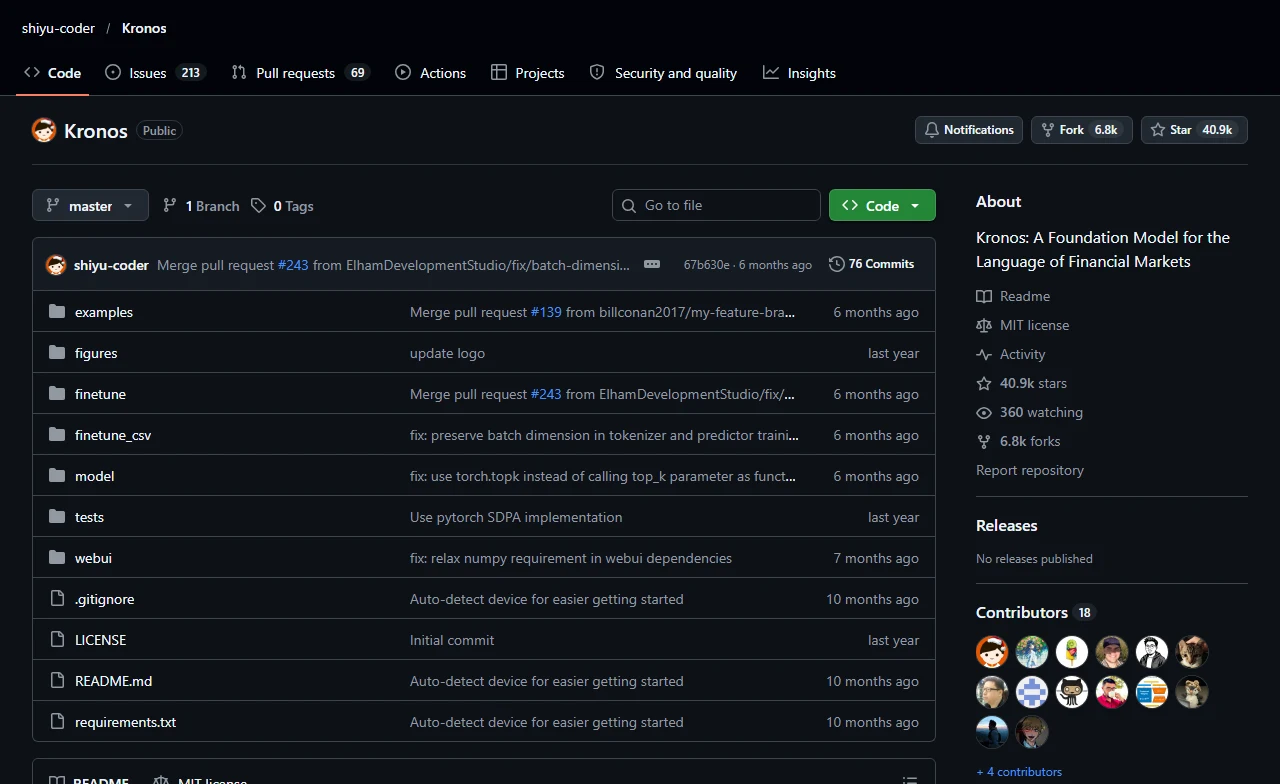
Kronos describes itself as the first open-source foundation model for financial candlesticks, also called K-lines. It was trained on more than 12 billion candlestick records from 45 exchanges around the world, and the accompanying paper, Kronos: A Foundation Model for the Language of Financial Markets, was accepted at AAAI 2026. You give it a table of past open, high, low, close and volume values, and it returns a forecast of the candles that come next.
When we checked on 17 October 2026, the repository had 40.9k stars, 6.8k forks, 213 open issues and 18 contributors. The last change to the main branch was in April 2026, about six months earlier. That matters for a business: you are adopting research code with an active community, not a product with a support contract, so plan to read the code, pin versions and fix problems yourself.
The repository is honest about its limits. Its README says the fine-tuning pipeline is a demonstration and not a production-ready quantitative trading system, that its signals are raw predictions, and that a real workflow needs portfolio construction, position sizing, risk management and realistic modelling of costs, slippage and market impact. That is the gap this guide fills, and it is also where paid work lives.
Kronos is also not a crystal ball. It produces a sampled guess at future prices, and two runs on the same data can differ unless you fix a random seed. Markets react to news, liquidity and other traders' behaviour, and none of that is guaranteed to repeat. Treat every forecast as one input to a rule you have tested, never as an instruction.
How Kronos works, in plain English
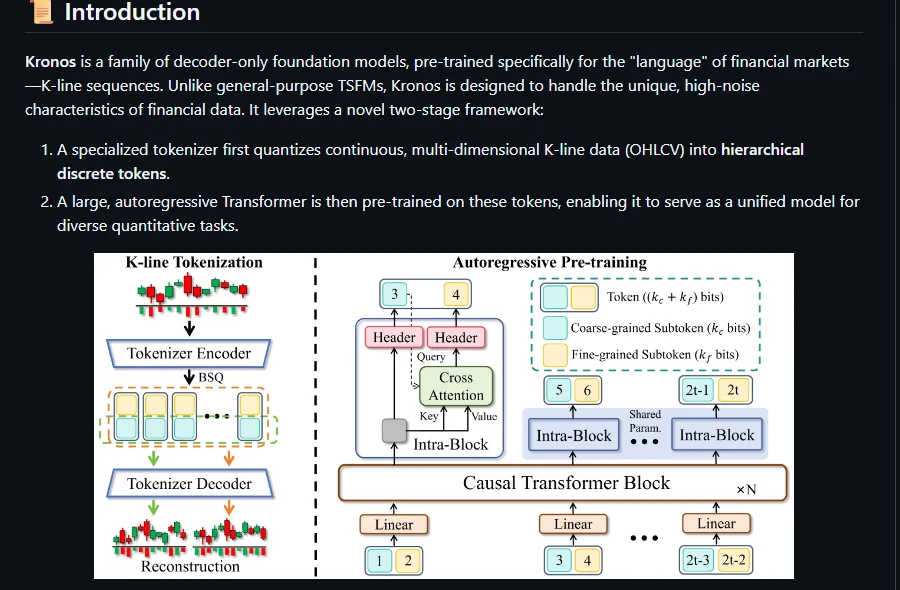
Large language models work on tokens, the small pieces of text they predict one after another. Kronos applies the same idea to price data, in two stages.
Stage one: the tokenizer. A specialised tokenizer takes each candle's open, high, low, close, volume and amount and compresses it into discrete codes. Each code has a coarse part and a fine part. The coarse part captures the broad shape of the movement and the fine part adds detail. The diagram's decoder shows the reverse trip: tokens turned back into candlesticks, which is how forecasts become prices you can read.
Stage two: the predictor. A decoder-only transformer, the same family of architecture as GPT-style models, is pre-trained to predict the next token from all the tokens before it. To forecast 24 hours ahead on hourly data, it predicts one candle, adds it to the context and repeats. Sampling settings control how adventurous that guess is: temperature (T) and nucleus sampling (top_p) work as they do in text models, and sample_count runs several paths and averages them.
What the paper reports. The authors report a 93% improvement in RankIC over the leading general time-series foundation model on price forecasting, and 87% over the best model trained without pre-training. They also report 9% lower error on volatility forecasting and 22% better fidelity when generating synthetic candlesticks. RankIC measures how well forecasts rank assets against each other. It is a useful research metric, but it is not profit. Your own backtest, on your market, with your costs, is the only result that counts.
The released models differ mainly in size and context length. More parameters can capture more patterns but need more memory and time per forecast. Start with Kronos-small; it is the best balance for a CPU server.
| Model | Parameters | Context length | Weights | Good first use |
|---|---|---|---|---|
| Kronos-mini | 4.1M | 2,048 candles | NeoQuasar/Kronos-mini | Long histories on modest hardware |
| Kronos-small | 24.7M | 512 candles | NeoQuasar/Kronos-small | The default for learning and CPU servers |
| Kronos-base | 102.3M | 512 candles | NeoQuasar/Kronos-base | Comparison once your pipeline works; a GPU helps |
| Kronos-large | 499.2M | 512 candles | Not released | Not available to download |
Where Grok and Grok Bot fit
"Grok" now means two different things, and a trading project can use both.
The Grok API is xAI's developer platform. You send text and get a reply, priced per million tokens. The xAI models page listed grok-4.3 at $1.25 per million input tokens and $2.50 per million output tokens, and grok-4.7 at $2.00 and $6.00, when we checked. The API accepts the OpenAI Python SDK pointed at https://api.x.ai/v1. In a bot, its sensible job is reading headlines and flagging unusual risk: an exchange outage, a hack, a delisting, regulatory action.
Grok Bot is xAI's always-on agent product, launched in beta in August 2026. According to xAI's design notes, each Bot has its own memory, tools and cloud computer, so it keeps working when your laptop is closed. Skills and routines let a Bot repeat a task on a schedule or after an event. Routines must be at least five minutes apart, and xAI's own guidance says to require approval for purchases, publishing and changes to production systems. Launch coverage reported access through SuperGrok Heavy and certain Cursor plans, such as Cursor Ultra at $200 a month. Check current plans before budgeting.
Those limits tell you where Grok Bot belongs: as the operations teammate, not the trading engine. Good jobs for it are reading the trade journal every morning, comparing live results with the backtest, chasing a failing data feed, drafting a weekly performance report and alerting you when something looks wrong. Order placement should stay inside your own code, with hard limits that no language model can talk its way around.
We found no established open-source project called "GrokBot" for trading. Several crypto tokens use the name, and they have nothing to do with xAI. Ignore anything that asks you to buy a token to use a bot.
The business ideas behind Kronos
Most people who search for a Kronos trading bot want a machine that makes money while they sleep. That product does not exist, and selling it as if it did is how traders lose money and builders end up in regulatory trouble. The durable opportunities are in tooling, infrastructure and services around forecasting, where you get paid for work you can actually deliver.
The table compares seven routes. The difficulty and regulatory notes are editorial judgements to help you shortlist, not legal advice.
| Business | Who pays | What you deliver | Main risk |
|---|---|---|---|
| Forecast research dashboard | Active traders, trading educators | Charts of Kronos forecasts beside actual outcomes, with track records | Being read as investment advice |
| Backtesting as a service | Traders testing their own rules | Upload a strategy, get honest walk-forward results with costs | Compute costs and data licensing |
| Forecasting API | Developers and fintech teams | An endpoint that returns Kronos forecasts for supplied candles | Uptime, latency and abuse |
| Custom quant builds | Funds, prop desks, family offices | Fine-tuned models, data pipelines and research tooling | Long sales cycles; strict confidentiality |
| White-label analytics | Brokers, investment clubs, SACCOs | Branded forecast and risk views for their members | Partner compliance reviews |
| Synthetic market data | Risk teams, researchers, educators | Realistic simulated candlesticks for stress tests and teaching | Proving the data is realistic enough |
| Training and courses | Developers learning quant work | Courses and workshops on building and testing bots | Overpromising returns |
Business models that hold up, and ones to avoid
Sell tools, not returns. A dashboard, an API or a backtesting service charges for software and compute. The customer makes their own decisions. A service that promises profits, pools customers' money or trades on their behalf is a different business: it is regulated, it carries liability, and one bad month can end it.
Sell honesty as the feature. Most trading products show cherry-picked charts. A product that shows every forecast beside what actually happened, including the bad weeks, is rare, and that makes it easier to trust. Keep a public, timestamped track record from the day you launch, and never edit it.
Custom builds are the fastest route to revenue. One prop desk or fund that wants Kronos fine-tuned on its own markets, with a clean data pipeline and a research notebook, can pay for months of development. That money also funds a later SaaS. Write scope, data ownership and confidentiality into the contract.
Synthetic data is the quiet opportunity. The paper reports that Kronos can generate realistic synthetic candlesticks. Risk teams and educators need realistic market scenarios that are not just copies of history. It is a narrower market, but there is little regulatory exposure and it uses a capability most people ignore.
Avoid: signal groups that charge for buy and sell calls, 'guaranteed' copy-trading, managing other people's exchange accounts, and any token tied to your bot. These invite fraud complaints and regulatory action, and they turn a technical project into a trust problem.
The architecture of a careful trading bot
Before writing code, decide what each part is allowed to do. Bots that blow up accounts usually fail at the boundaries between parts: a forecast that is trusted blindly, a risk check that can be skipped, or an order that gets sent twice after a network error. Keep these six parts separate, so each can be tested and replaced on its own:
- Data collector. Fetches closed candles from an exchange or broker, checks for gaps and duplicates, and stores them. If data is late or missing, everything downstream must stop.
- Forecaster. Kronos takes the last few hundred candles and returns a forecast. It has no knowledge of your account and cannot place orders.
- Decision rules. Plain code that turns a forecast into BUY or FLAT using thresholds fixed in your backtest. Do not let a language model invent rules on the fly.
- Risk manager. Hard limits that can veto any trade: maximum position size, maximum daily loss, maximum number of trades, a kill switch, and Grok's news veto. A veto always wins.
- Execution adapter. The only part holding exchange API keys. It sends orders, records order IDs, retries safely without creating duplicates, and reconciles positions with the exchange.
- Journal and supervisor. Every decision, veto and order goes into a log. Grok Bot can read the log on a schedule, compare it with the backtest and alert you, but it does not trade.
Step 1: set up your computer
You need Python 3.10 or newer, Git and about 2 GB of free disk space for the models and libraries. A normal laptop is enough to learn on. Kronos detects whether you have an NVIDIA GPU (CUDA), an Apple Silicon chip (MPS) or only a CPU, and its web UI supports all three. A GPU only becomes important when you fine-tune or run thousands of forecasts.
Create a virtual environment so this project's libraries cannot conflict with anything else on your machine. The extra packages are CCXT for exchange data (MIT licence), alpaca-py for paper trading (Apache 2.0), the OpenAI SDK for Grok's compatible API, and python-dotenv for keeping secrets out of your code.
If you would rather click than code at first, the repository includes a web UI. Run python run.py inside the webui folder, open http://localhost:7070, load a CSV and see forecasts drawn against actual candles. It is a quick way to build intuition before automating anything.
# 1. Get the code and an isolated Python environment (Python 3.10+)
git clone https://github.com/shiyu-coder/Kronos.git
cd Kronos
python -m venv .venv
# Windows: .venv\Scripts\activate    macOS/Linux: source .venv/bin/activate
pip install -r requirements.txt

# 2. Libraries this guide adds on top of Kronos
pip install ccxt alpaca-py openai python-dotenv
Step 2: get clean market data
Kronos needs a table with timestamps, open, high, low and close columns. Volume and amount are optional, but use them when you have them. Crypto is the easiest place to learn, because exchanges publish candles for free and trade around the clock. US stocks through Alpaca are a second option: free paper accounts get IEX market data.
The script below downloads the last 1,000 hourly BTC/USDT candles from Binance's public endpoint. Public market data needs no API key. Check the exchange's terms before storing or redistributing data in a commercial product. Data rights are a real cost for a SaaS, even when the API is free.
Check three things before trusting any dataset. Make sure the last candle is closed (a candle that is still forming will mislead the model). Look for missing hours, which usually mean an outage. And check for duplicate timestamps. Bad data produces forecasts that look confident and are wrong.
# get_data.py - download hourly candles from a public exchange endpoint
import ccxt
import pandas as pd

exchange = ccxt.binance()          # public market data needs no API key
bars = exchange.fetch_ohlcv("BTC/USDT", timeframe="1h", limit=1000)

df = pd.DataFrame(bars, columns=["timestamps", "open", "high", "low", "close", "volume"])
df["timestamps"] = pd.to_datetime(df["timestamps"], unit="ms")
df["amount"] = df["close"] * df["volume"]      # quote volume, used by Kronos
df.to_csv("btc_usdt_1h.csv", index=False)
print(df.tail())
Step 3: make your first Kronos forecast
This follows the official README: load the tokenizer and Kronos-small from Hugging Face, build a predictor with a 512-candle context, then call predict. The first run downloads the weights, which can take a few minutes.
Use 400 candles of history to forecast 24 ahead. For future periods you have not seen yet, you must create the timestamps yourself, which the date_range line does. Setting sample_count to 5 averages five sampled paths, which smooths out randomness at the cost of five times the computation. Time this script on the server you plan to use, because that number decides how many markets and timeframes you can afford to cover.
Plot the forecast against what actually happens next a few dozen times before automating anything. You will see that forecasts are often directionally sensible and rarely precise. That is normal, and it is exactly why the next two steps exist.
# forecast.py - run inside the cloned Kronos folder so "model" imports work
import pandas as pd
import torch
from model import Kronos, KronosTokenizer, KronosPredictor

torch.manual_seed(42)   # forecasts are sampled; a seed makes runs repeatable

tokenizer = KronosTokenizer.from_pretrained("NeoQuasar/Kronos-Tokenizer-base")
model = Kronos.from_pretrained("NeoQuasar/Kronos-small")
predictor = KronosPredictor(model, tokenizer, max_context=512)

df = pd.read_csv("btc_usdt_1h.csv", parse_dates=["timestamps"])
cols = ["open", "high", "low", "close", "volume", "amount"]
lookback, horizon = 400, 24

hist = df.tail(lookback).reset_index(drop=True)
future = pd.Series(pd.date_range(hist["timestamps"].iloc[-1] + pd.Timedelta(hours=1),
                                 periods=horizon, freq="1h"))

pred = predictor.predict(df=hist[cols], x_timestamp=hist["timestamps"],
                         y_timestamp=future, pred_len=horizon,
                         T=1.0, top_p=0.9, sample_count=5)
print(pred[["open", "high", "low", "close"]].tail())
Step 4: turn the forecast into a rule
A forecast is not a trade. You need a rule that says when the predicted move is big enough to be worth the costs. Every round trip pays a fee to enter, a fee to exit and some slippage, so a predicted rise of 0.1% is worthless if the trade costs 0.3%.
The rule below buys only when the expected move clears the round-trip cost plus a safety margin. It is long-only and spot-only on purpose: no shorting, no leverage and no borrowed money. Leverage turns a modelling mistake into a margin call. Learn on the simplest version that can lose only what you put in.
Fix the fee, slippage and margin numbers before you backtest, and do not tune them afterwards until the results look good. Tuning settings to fit past data is called overfitting, and it is the most common way a beautiful backtest becomes a losing bot.
# rules.py - turn a forecast into a decision you can test
FEE = 0.001        # 0.1% per side: replace with your venue's actual fee
SLIPPAGE = 0.0005  # assumed cost of not getting the quoted price
MARGIN = 0.002     # extra edge required before acting at all

def decide(last_close: float, forecast_close: float) -> tuple[str, float]:
    expected = forecast_close / last_close - 1
    hurdle = 2 * (FEE + SLIPPAGE) + MARGIN     # round trip plus margin
    if expected > hurdle:
        return "BUY", expected
    return "FLAT", expected                  # spot, long-only: no shorting
Step 5: backtest it honestly
A backtest replays history to see what your rule would have done. Done carelessly, it lies. The script below is a walk-forward test: at each step, Kronos sees only the 400 candles before the decision time, makes a forecast, and the trade is scored on the real candles that followed. Trades do not overlap, and fees and slippage are subtracted from every trade.
Read the output against four questions. Did it beat buy-and-hold after costs, over the same period? What was the maximum drawdown, the largest fall from a peak, and could you live through it without switching the bot off? How many trades were there? Twenty trades prove nothing. Did direction agreement beat a coin flip by a clear margin, or is the profit coming from one lucky stretch?
Then try to break it. Re-run with a different random seed, double the fees, test a different year and a different asset, and hold back the most recent three months completely until the very end. A real edge survives these changes. An accidental one disappears. If it survives, look at the trade log by hand: losing trades often reveal problems with data, timing or costs that summary statistics hide.
Common backtest lies: look-ahead bias (using any information that would not have existed at decision time), survivorship bias (testing only assets that still exist today), ignoring fees and slippage, assuming you trade at prices nobody would have offered you, and testing a hundred variations and reporting the best one. The Kronos README's own warning about costs, slippage and market impact applies here.
Licence note for SaaS builders: popular backtesting libraries carry different licences. backtesting.py is AGPL-3.0, which can require you to publish your source code if users access it over a network. Freqtrade is GPL-3.0. Kronos and CCXT are MIT. The simple loop here avoids that question, and for a commercial product you should get the licence mix reviewed early.
# backtest.py - walk-forward test: the model never sees the future it predicts
import numpy as np
import pandas as pd
from forecast import predictor, df, cols          # reuse the loaded model
from rules import decide, FEE, SLIPPAGE

LOOKBACK, HORIZON = 400, 24
STEP = HORIZON           # non-overlapping trades keep the arithmetic honest
rows = []
for start in range(LOOKBACK, len(df) - HORIZON, STEP):
    hist = df.iloc[start - LOOKBACK:start].reset_index(drop=True)
    future_ts = df["timestamps"].iloc[start:start + HORIZON].reset_index(drop=True)
    pred = predictor.predict(df=hist[cols], x_timestamp=hist["timestamps"],
                             y_timestamp=future_ts, pred_len=HORIZON,
                             T=1.0, top_p=0.9, sample_count=5)
    entry = hist["close"].iloc[-1]
    exit_ = df["close"].iloc[start + HORIZON - 1]
    action, expected = decide(entry, pred["close"].iloc[-1])
    gross = exit_ / entry - 1
    net = gross - 2 * (FEE + SLIPPAGE) if action == "BUY" else 0.0
    rows.append({"time": df["timestamps"].iloc[start], "action": action,
                 "expected": expected, "actual": gross, "net": net})

res = pd.DataFrame(rows)
equity = (1 + res["net"]).cumprod()
trades = res[res["action"] == "BUY"]
print("trades:", len(trades))
print("hit rate:", round((trades["net"] > 0).mean(), 3))
print("strategy return:", round(equity.iloc[-1] - 1, 4))
print("buy and hold:", round(df["close"].iloc[-1] / df["close"].iloc[LOOKBACK - 1] - 1, 4))
print("max drawdown:", round((equity / equity.cummax() - 1).min(), 4))
print("direction agreement:", round((np.sign(res["expected"]) == np.sign(res["actual"])).mean(), 3))
res.to_csv("backtest_trades.csv", index=False)Step 6: paper trade before real money
Paper trading runs your bot against live prices with fake money. It catches the problems a backtest cannot: delayed data, rejected orders, time-zone mistakes, crashes at 3am, and duplicate orders after a network error. Run it for at least a few weeks, long enough to see a range of market conditions.
Alpaca's paper trading is free and open to anyone worldwide with an email address. It starts with a simulated $100,000 balance, uses the same API as live trading, and also covers crypto. Alpaca notes that paper trading does not model market impact, slippage from latency or several fees, so expect live results to be worse. For crypto, the Binance Spot Test Network gives virtual balances through the same API. It is reset about once a month without notice, so keep your own records.
The sketch shows the habits that matter. Keys are loaded from a .env file and never written into code. The position size has a hard ceiling. A file named STOP halts all new orders instantly. Stale data is skipped instead of traded on. Every outcome is written to an append-only journal. Compare the paper journal with your backtest every week: if the hit rate or average trade differs a lot, find out why before going further.
# paper_trade.py - one decision cycle against Alpaca's paper account
import os, json, pathlib, datetime as dt
from dotenv import load_dotenv
from alpaca.trading.client import TradingClient
from alpaca.trading.requests import MarketOrderRequest
from alpaca.trading.enums import OrderSide, TimeInForce

load_dotenv()                                   # keys live in .env, never in code
client = TradingClient(os.environ["APCA_KEY"], os.environ["APCA_SECRET"], paper=True)

MAX_NOTIONAL = 500           # dollars per position: the hard ceiling
KILL_SWITCH = pathlib.Path("STOP")   # create this file to halt all new orders

def place(symbol: str, action: str, expected: float, data_age_minutes: float):
    if KILL_SWITCH.exists():
        return log("halted", symbol)
    if data_age_minutes > 90:
        return log("stale data, skipped", symbol)
    if action != "BUY":
        return log("no trade", symbol, expected)
    order = MarketOrderRequest(symbol=symbol, notional=MAX_NOTIONAL,
                               side=OrderSide.BUY, time_in_force=TimeInForce.GTC)
    result = client.submit_order(order_data=order)
    log("submitted", symbol, expected, str(result.id))

def log(*fields):
    line = {"at": dt.datetime.now(dt.timezone.utc).isoformat(), "event": fields}
    with open("journal.jsonl", "a") as f:
        f.write(json.dumps(line, default=str) + "\n")
Step 7: let it trade, carefully
Going live is a risk decision, not a coding milestone. Only use money you can afford to lose completely, and start with a small fraction of what you eventually intend to run. Increase it only after weeks of live results that match the paper results. Before the first live order, work through this checklist:
- Create trade-only API keys: no withdrawal permission, restricted to your server's IP address where the exchange supports it.
- Set hard limits in code and on the exchange where possible: maximum position size, maximum daily loss and maximum trades per day. The bot stops for the day when it hits a limit.
- Reconcile every cycle: compare the positions your bot thinks it has with what the exchange reports. Stop and alert on any mismatch.
- Make every order idempotent: use client order IDs so a retry after a timeout cannot create a second position.
- Alert on silence: if no cycle has completed for two hours, send an alert. A bot that has quietly died is as dangerous as one that is misbehaving.
- Keep the kill switch one step away, and test that it works. You should be able to stop new trading from your phone in under a minute.
- Start with one market and one timeframe. Add more only when the first has run without surprises.
- Write down in advance when you will switch it off: a drawdown level, a number of losing weeks, or a gap between live and backtest results. Decide while you are calm, not in the middle of a losing day.
Step 8: add Grok as a news check and a supervisor
Candlesticks cannot see news. A forecast made one minute before an exchange announces a hack is still based on yesterday's pattern. A language model reading recent headlines can catch some of that, as long as you limit what it is allowed to do.
In the script below, Grok receives recent headlines and must answer with a fixed JSON shape: normal or elevated risk, plus a reason. Elevated risk vetoes new trades for that cycle. Grok cannot size or place a trade. If its reply cannot be read, the code treats it as elevated, so a broken API fails safe rather than open. Temperature 0 keeps answers consistent.
The cost is small. Suppose each hourly check sends about 20,000 input tokens and receives 2,000 output tokens. That is 480,000 input and 48,000 output tokens a day, or about $0.60 plus $0.12 at grok-4.3 prices: roughly $22 a month for one asset checked every hour. Check fewer times, or send fewer headlines, and it drops quickly.
Grok Bot routines for supervision. Give a Bot a skill such as: every weekday at 08:00 East Africa Time, read the last 24 hours of the journal, compare hit rate, average trade and drawdown with the backtest, check that cycles ran every hour, and draft a short report. Add a second routine that alerts you if no cycle ran for two hours. Require approval for any change to configuration. That gives a solo operator a second pair of eyes without giving an AI the keys to the account.
# news_check.py - Grok as a veto on unusual news, never as the trader
import os, json
from openai import OpenAI

client = OpenAI(api_key=os.environ["XAI_API_KEY"], base_url="https://api.x.ai/v1")

def news_risk(asset: str, headlines: list[str]) -> dict:
    prompt = (f"Headlines about {asset} from the last 6 hours:\n- " + "\n- ".join(headlines) +
              "\n\nReturn JSON only: {\"risk\": \"normal\" or \"elevated\", "
              "\"reason\": \"one sentence\"}. Mark elevated only for exchange outages, "
              "hacks, regulatory action, delistings or extreme events.")
    reply = client.chat.completions.create(
        model="grok-4.3", temperature=0,
        messages=[{"role": "user", "content": prompt}])
    try:
        return json.loads(reply.choices[0].message.content)
    except (json.JSONDecodeError, TypeError):
return {"risk": "elevated", "reason": "unreadable model reply"} # fail safe# /etc/cron.d/kronos-bot (Ubuntu VPS, server clock in UTC)
# Run five minutes after every hour, once the previous candle has closed.
5 * * * * botuser cd /opt/kronos-bot && .venv/bin/python run_cycle.py >> logs/cycle.log 2>&1
# Nightly copy of the trade journal and database to separate storage
30 0 * * * botuser /opt/kronos-bot/scripts/backup.sh >> logs/backup.log 2>&1The servers you need
A trading bot needs a computer that never sleeps, so your laptop is fine for research but not for running live. The good news is that hourly Kronos-small forecasts for a handful of markets do not need a GPU. A small Linux virtual private server (VPS) is enough. Here is how the pieces map to infrastructure:
| Component | What it needs | Example option | When to upgrade |
|---|---|---|---|
| Research and development | Your laptop, Python, 8 GB RAM or more | Your current computer | When backtests take hours |
| Production bot (solo) | Always-on Linux VPS, 2 to 4 GB RAM | DigitalOcean 2 GiB ($12/mo) or 4 GiB/2 vCPU ($24/mo) | When forecasting time approaches your cycle length |
| Fine-tuning | An NVIDIA GPU, rented by the hour | RunPod RTX 4090 ($0.34 to $0.89/hr) or A100 ($1.19 to $1.79/hr) | Only when you fine-tune or run Kronos-base at scale |
| Database | PostgreSQL or SQLite for candles and the journal | SQLite on the VPS to start; managed PostgreSQL later | Multiple users, or more than one bot |
| Backups | Off-server copies of the journal and configuration | Object storage or a second provider | From day one: this is not optional |
| Monitoring and alerts | Heartbeat checks, error alerts, uptime | A free uptime monitor, Telegram or email alerts, a Grok Bot routine | When you take on paying users |
Where to host, and why location matters less than you think
For an hourly strategy, it makes no practical difference whether your server is in Frankfurt, Singapore or the US: a few hundred milliseconds of network delay is irrelevant when you trade once an hour. Choose a provider with a reliable track record, easy backups, and a region allowed by your exchange's terms. Some exchanges block certain countries' IP addresses, so check before you rent.
Location does matter for strategies that trade every few seconds, but Kronos is not designed for that. Each forecast runs a transformer, and high-frequency trading is a competition decided by microseconds and specialised hardware. Do not try to win it with a foundation model on a $12 server.
Secure the server like it holds money, because it does: SSH keys instead of passwords, a firewall that only allows SSH, automatic security updates, a separate non-root user for the bot, and API keys readable only by that user. Never commit the .env file to GitHub.
Cost breakdown: what this really costs per month
The figures below use prices from DigitalOcean, RunPod and xAI as listed on 17 October 2026. They exclude your time, taxes, exchange fees and trading losses, which are usually the largest costs. Treat them as planning ranges, not quotes.
| Stage | What runs | Estimated monthly cost |
|---|---|---|
| 1. Learn and paper trade | Laptop for research; 1 to 2 GiB VPS ($6 to $12); free public or paper market data; occasional Grok API calls | About $10 to $20 |
| 2. Solo live bot | 4 GiB VPS ($24); hourly Grok news checks (about $22); backups; a few GPU hours a month for fine-tuning ($3 to $18) | About $50 to $80 |
| 2b. Add Grok Bot supervision | A plan that includes Grok Bot, such as Cursor Ultra as reported at launch | From about $200 on top |
| 3. SaaS MVP | Two app servers ($48 each); a forecasting worker ($96); managed database; monitoring; email; Grok API usage that grows with users | About $300 to $700 before legal, compliance and marketing |
| One-off: fine-tuning experiment | 10 to 40 GPU hours on an RTX 4090 or A100 | About $5 to $70 per experiment |
How to turn this into a SaaS
A SaaS version lets many users get forecasts, run backtests or watch their own bots without installing Python. The core design decision is whether you ever touch customers' money. Our strong recommendation for a first product is no: a non-custodial tool that informs decisions and never holds funds or trading keys is far simpler to secure, explain and license.
Product shape. Start with one job done well. A good example is a backtesting and forecast-tracking dashboard: the user picks a market and timeframe, sees Kronos forecasts beside actual results, uploads simple rules and gets an honest walk-forward report with costs. That is valuable, demonstrable and not trading on anyone's behalf.
Architecture. Keep the web app (Next.js or similar), the API and the forecasting workers separate. Put forecast and backtest jobs on a queue so a burst of users cannot crash the site. Cache forecasts: if 200 users want hourly BTC/USDT, run Kronos once and serve it 200 times. Store candles once and share them. Rate-limit expensive backtests by plan.
Pricing ideas. Tier by compute and coverage, not by promised returns. For example: a free tier with delayed forecasts for two markets; a paid tier with live forecasts, more markets and a set number of backtest hours; and a team or API tier for developers. The numbers depend on your costs and market, so test them with real customers before fixing them.
If you later offer automated trading, let users connect their own exchange accounts with trade-only, IP-restricted keys stored encrypted, and give them their own limits and kill switch. Before that point, get legal advice, because in Kenya and most other jurisdictions it changes what licence you need.
Licences and attribution. Kronos code and weights are MIT, so keep the copyright notice in your distribution and credit the authors. Check every other dependency, especially AGPL and GPL code in anything you offer over a network or distribute.
How to turn it into a trading engine
A trading engine is the reusable core underneath many strategies: it receives market data, runs strategies, enforces risk, manages orders and keeps the books. Building one is a serious engineering project, and it is also a sellable asset to funds, prop desks and fintech companies. The parts that make it an engine rather than a script are:
- Event-driven core. Market data, timers, fills and errors are all events in one ordered stream, so a replay of yesterday's events produces exactly the same decisions. That makes backtesting and live trading run the same code.
- Pluggable strategies. Kronos becomes one signal provider among several, behind a common interface. Swapping a model should not require touching order code.
- Pre-trade risk engine. Every order passes through limits on position, exposure, loss, order rate and price sanity before it can leave the system.
- Order management system. It tracks each order's life (new, acknowledged, partially filled, filled, cancelled, rejected), uses idempotent client IDs and reconciles with the venue.
- Venue adapters. One adapter per exchange or broker, isolating API quirks. CCXT can speed this up for crypto venues.
- Audit trail. An immutable record of every input, decision and order. Clients, auditors and regulators will ask for it, and so will you after a bad day.
- Operations. Health checks, alerting, deployment without downtime and a documented incident process. Grok Bot routines can help here as a reviewer, with approval required for any change.
Kenya: regulation you must know before charging anyone
We are not lawyers, and this is not legal advice. It does show where the lines now are.
Automated advice is licensed. Kenya's Capital Markets (Licensing Requirements) (General) Regulations, 2025 replaced the 2002 framework. Law-firm summaries from Bowmans and ENS report that the definition of investment adviser now covers digital platforms that give automated, algorithm-driven advice, and that a separate intermediary service platform licence covers apps that channel users to capital markets products. Reported requirements include documented methodologies, risk management, client onboarding and long record retention. A product that tells Kenyan users what to buy may therefore need a Capital Markets Authority licence.
Crypto has its own law. The Virtual Asset Service Providers Act, 2025 came into force on 4 November 2025, according to the Central Bank of Kenya. It makes the CBK and the CMA the licensing authorities for virtual asset service providers. In late 2025 both regulators said no provider had yet been licensed under it, and that licensing would begin once Treasury issued the implementing regulations. Check the current position before offering any crypto service.
Data protection applies too. Exchange keys, trading history and identity details are personal data under Kenya's Data Protection Act. Encrypt them, collect only what you need and have a clear privacy policy.
The safest first product is software that analyses public market data, shows its full track record, avoids personalised recommendations and never holds customer funds or keys. Talk to a capital markets lawyer before adding anything closer to advice or execution.
Common mistakes, and how to avoid them
Most of these mistakes come from moving too quickly. The slow path (research, backtest, paper trading, small live trading, then scale) feels tedious, but each stage is cheap compared with the losses it prevents.
- Trusting a single backtest. Change the period, asset, seed and costs. If the result collapses, it was luck.
- Trading a candle that has not closed. Always forecast from completed candles, and schedule cycles a few minutes after the close.
- Letting an AI decide position size. Language models are inconsistent and can be manipulated by text they read. Keep sizing in deterministic code.
- Leverage while learning. It turns small modelling errors into account-ending losses.
- No reconciliation. If the bot's idea of your position differs from the exchange's, every later decision is wrong.
- Keys with withdrawal rights. A leaked trade-only key can cause losses. A leaked withdrawal key can empty the account.
- Selling the dream. Screenshots of winning weeks attract customers who leave angry after the losing ones. Publish the full record or nothing.
A practical 30-day plan
Days 1 to 5: install Kronos, run the README example and the web UI, and read the model code until you understand the inputs and outputs. Download a year of hourly data for one market.
Days 6 to 12: write the walk-forward backtest with costs. Record the results, then try to break them with different seeds, periods, assets and doubled fees. Keep a written log of every variation you try, including the failures.
Days 13 to 15: if a rule survives, set up a VPS with backups, the kill switch, journal logging and silence alerts. If nothing survives, that is a valid result. Move on to a forecasting dashboard or synthetic-data idea rather than forcing a trading strategy.
Days 16 to 28: paper trade continuously. Add the Grok news veto and a Grok Bot morning-report routine. Compare paper results with the backtest every week.
Days 29 to 30: decide, using written criteria set on day 1, whether to go live with a small amount, keep paper trading or change direction. Download the checklist below to keep the plan in one place.
Questions people ask
Is Kronos free to use commercially?
The Kronos code is MIT-licensed, and the released model weights on Hugging Face (Kronos-mini, small and base, and their tokenizers) are also listed as MIT. You can build commercial products on them if you keep the copyright and licence notice. Kronos-large has not been released. Check the licences of any other libraries you combine with it.
Can Kronos predict the stock market or crypto prices accurately?
Kronos produces probabilistic forecasts that the paper shows beat other models on research benchmarks. That is not the same as reliable trading profits. Forecasts are often directionally useful and rarely precise, and they cannot account for news. Only a walk-forward backtest with costs, followed by paper trading on your own market, can tell you whether a strategy using it is worth running.
Do I need a GPU to run a Kronos trading bot?
Not to start. Kronos-small has 24.7 million parameters and runs on a CPU, so an hourly bot for a few markets can run on a small VPS. A rented GPU makes sense for fine-tuning, for running Kronos-base at scale, or for backtests that make thousands of forecasts.
What is Grok Bot, and can it trade for me?
Grok Bot is xAI's always-on agent product with its own memory, tools and cloud computer, launched in beta in August 2026. It can run scheduled routines at least five minutes apart, and xAI recommends requiring approval for actions such as purchases and changes to production systems. Use it to supervise and report on your bot, and keep order placement in your own code with hard risk limits.
How much money do I need to start an AI trading bot?
The software can run for about $10 to $20 a month while you learn and paper trade, which costs nothing in trading capital. When you go live, use only money you can afford to lose completely, start with a small fraction of it, and scale only after weeks of live results that match your tests.
Do I need a licence to sell a trading bot or signals in Kenya?
Possibly. Under Kenya's 2025 capital markets licensing regulations, automated algorithm-driven advice is reported to fall within the definition of investment adviser, and crypto services are covered by the Virtual Asset Service Providers Act, 2025. Software that only analyses public data and gives no personalised recommendations carries less risk, but get advice from a Kenyan capital markets lawyer before you charge customers.
Put this guide to work
Download a practical template, fill in your requirements and bring it to your project conversation.
- Kronos trading bot launch checklist ↓
Data checks, backtest tests, paper-trading criteria, live safety limits, server security and SaaS legal questions in one printable list.
Sources and research notes
Sources checked 17 October 2026. Recommendations and labelled scenarios are editorial guidance. Provider prices and capabilities can change; confirm them before purchasing.
- Kronos: upstream repository
Model purpose, architecture overview, model zoo, installation, prediction API, fine-tuning pipeline, web UI, disclaimers and repository metrics. Screenshots captured from this repository.
- Kronos: MIT licence
Licence for the Kronos code.
- Kronos: A Foundation Model for the Language of Financial Markets (arXiv 2508.02739)
Pre-training data scale, two-stage design and reported results on price forecasting, volatility and synthetic data generation.
- NeoQuasar/Kronos-small model card
Released model weights and MIT licence listing on Hugging Face.
- Kronos live demo
The authors' public BTC/USDT forecasting demonstration.
- xAI: Designing Grok Bot
Grok Bot's persistent memory, tools, cloud computer, skills and routines.
- xAI docs: skills, routines and automations
Skill and routine definitions, the five-minute minimum schedule interval and approval guidance.
- Unite.AI: xAI launches Grok Bot
Beta launch date and the access plans reported at launch.
- xAI docs: models and pricing
Grok model token prices and context windows used in the cost estimates.
- xAI docs: getting started
API base URL and OpenAI SDK compatibility.
- Alpaca: paper trading
Free global paper accounts, the simulated balance, the paper endpoint and what paper trading does not model.
- Binance Spot Test Network
Virtual-balance testing environment, endpoints and monthly resets.
- CCXT: upstream repository
Unified exchange API library used for market data; MIT licence.
- alpaca-py: upstream repository
Official Alpaca Python SDK used for paper orders; Apache 2.0 licence.
- backtesting.py: upstream repository
Backtesting library licensed AGPL-3.0, relevant to network-served products.
- Freqtrade: upstream repository
Open-source trading bot licensed GPL-3.0.
- DigitalOcean: Droplet pricing
VPS prices used in the infrastructure and cost tables.
- RunPod: GPU pricing
Hourly GPU rental prices used for fine-tuning estimates.
- Bowmans: Kenya capital markets licensing regime overhauled
Summary of the Capital Markets (Licensing Requirements) (General) Regulations, 2025.
- ENS: Kenya's new capital markets licensing framework
Robo-advisory and intermediary service platform licensing under the 2025 regulations.
- Central Bank of Kenya: Virtual Asset Service Providers Act 2025 notice
Commencement of the VASP Act and the licensing status for virtual asset service providers.

About this guide
AI-assisted research and original buyer checklists from the studio. Official documentation is linked above; examples are illustrative and do not describe verified client outcomes.
Ask Ken on WhatsApp