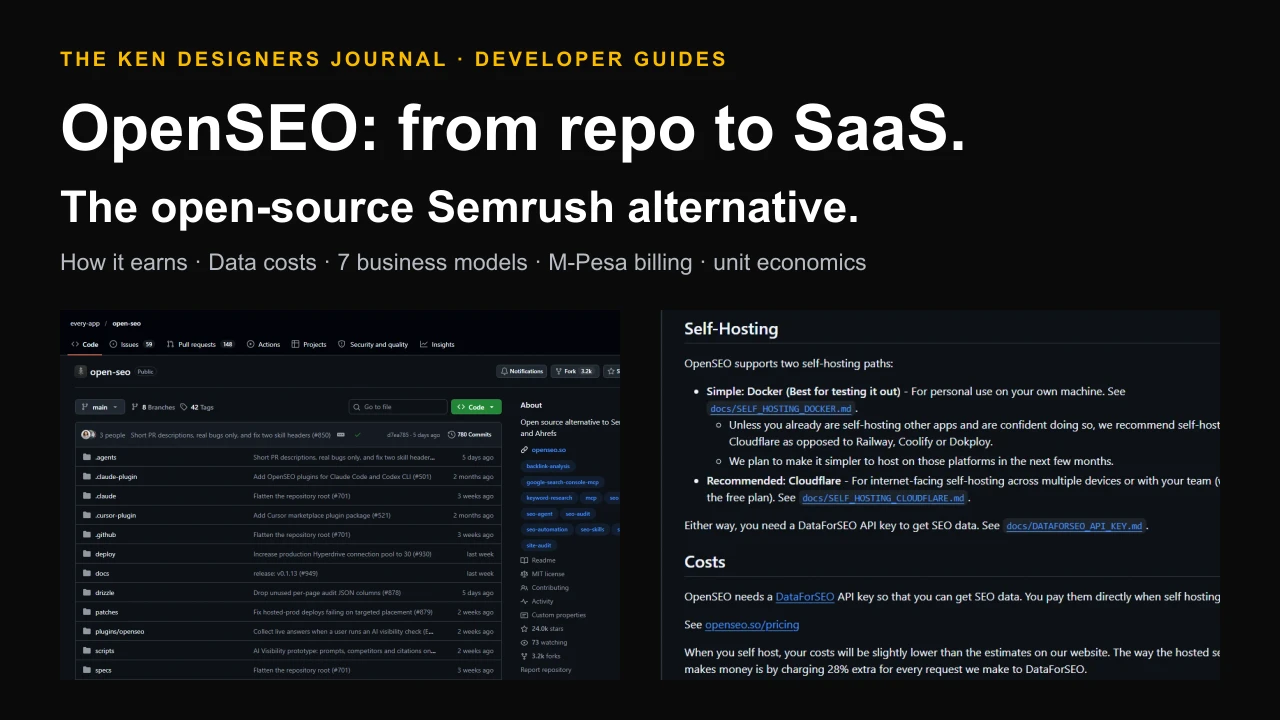
OpenSEO is an open-source alternative to Semrush and Ahrefs that you pay for by usage instead of an expensive monthly seat. It covers keyword research, rank tracking, competitor insights, backlinks, site audits and AI visibility, and it plugs into AI agents such as ChatGPT, Claude and Cursor. It reached 24,000 GitHub stars in under eight months and is MIT-licensed, which means you may build a commercial business on it. This guide explains how OpenSEO works, what its data really costs, exactly how its makers earn money from it, seven business models you could run with it, and a ten-step plan to turn it into your own SaaS, including taking payments by M-Pesa and doing the unit economics. No income is promised: every business model needs customers, delivery and support.
What OpenSEO is
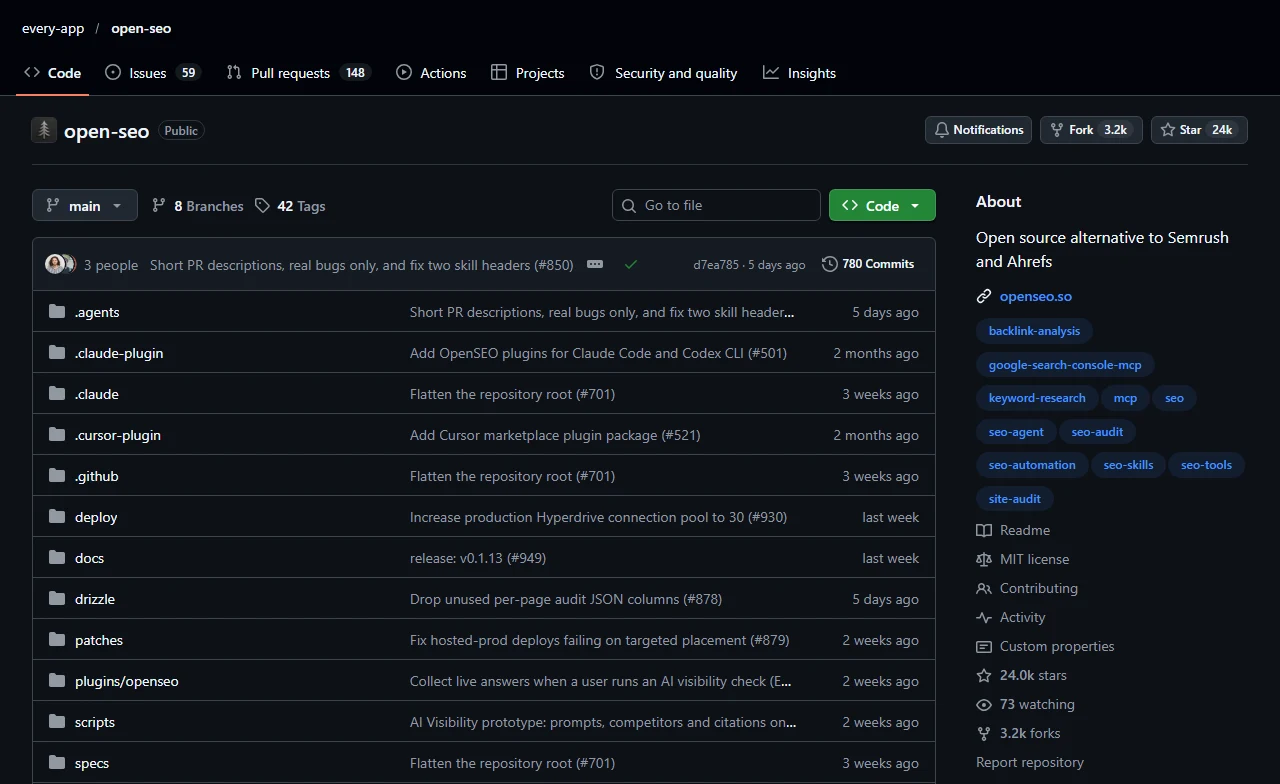
OpenSEO describes itself as an SEO tool for the people: if Semrush or Ahrefs are too expensive or bloated, it is a pay-as-you-go alternative you control. Instead of a fixed monthly seat, you connect your own DataForSEO account and pay only for the data you request, or you use the makers' hosted service.
The repository was created on 27 February 2026. When we checked on 18 October 2026 it had 23,995 stars, 3,218 forks, 20 contributors and about 780 commits, with the latest release, v0.1.13, published on 14 October 2026. The code is written in TypeScript and released under the MIT licence by Ben Senescu, under the every-app organisation.
It focuses on six workflows rather than trying to match every feature of the big suites: keyword research, rank tracking, competitor insights, backlinks, site audits and AI visibility, which checks whether your brand appears in AI assistants' answers. It also connects to Google Search Console and Google Analytics.
Its second big idea is that SEO now happens inside AI agents. OpenSEO exposes an MCP server, the standard way for AI assistants to use outside tools, plus ready-made agent skills, so you can ask ChatGPT, Claude, Codex or Cursor to run keyword research or an audit on your real data.
How it works under the hood
OpenSEO is a modern serverless web app. Knowing its parts tells you what running it as a business involves:
- Front end and server: React with TanStack Start, TanStack Router, Query and Table, built with Vite and styled with Tailwind.
- Runtime: Cloudflare Workers, so there is no server to patch. Long jobs run as Cloudflare Workflows: a site-audit workflow in its own worker, a rank-check workflow and an AI-visibility workflow. Scheduled triggers run every five minutes and once a night.
- Storage: Cloudflare D1 (SQLite) through the Drizzle ORM, KV for fast key-value data and OAuth state, and R2 for files. The hosted service can also run on Postgres.
- AI: an agent chat built on Cloudflare Durable Objects, the Vercel AI SDK and OpenRouter for model access, and an MCP server so external agents can call OpenSEO's tools.
- Accounts: three auth modes. Cloudflare Access for self-hosted teams, a no-login local mode for Docker, and a hosted mode using Better Auth with email and password, Google sign-in and organisations.
- Data: DataForSEO for keywords, search results, backlinks, on-page crawling and AI answers. Google Search Console data comes free from your own Google account.
- Billing (hosted mode): Autumn, a usage-billing layer that works with Stripe, manages plans, credits and top-ups.
- Operations: PostHog for analytics and error tracking, Loops for transactional email, and anonymised install telemetry that you can switch off with OPENSEO_TELEMETRY_DISABLED=1.
Two ways to run it yourself
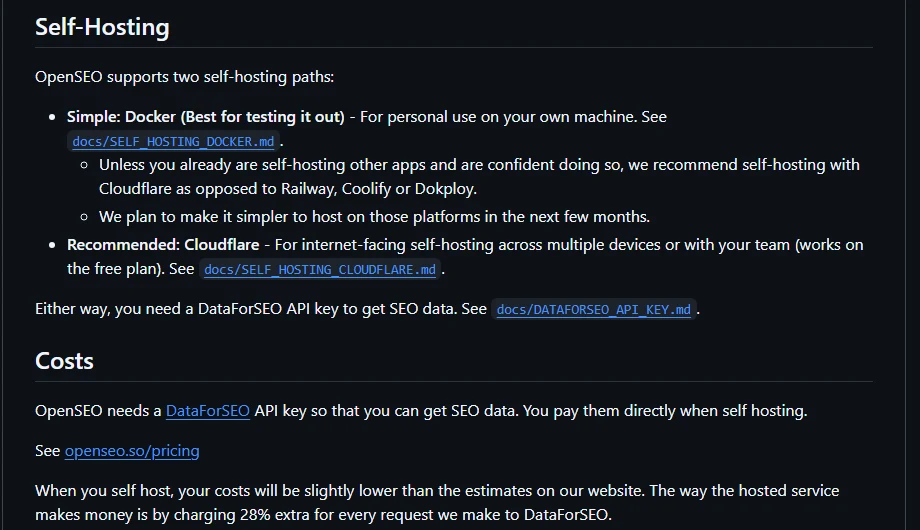
Docker is for trying it out on your own machine. It runs in a local mode with no login and a built-in admin user. The project warns you to expose it only behind your own authentication, a tunnel or a private network.
Cloudflare is the recommended route for anything internet-facing or shared with a team, and it works on Cloudflare's free plan. One deploy command creates the D1 database, KV namespaces, R2 bucket and Workers, applies migrations, and puts a Cloudflare Access login in front, allowing only the email addresses you list. R2 must be activated once in the dashboard, which needs a payment method on file even within the free tier.
Both routes need a DataForSEO API key. New DataForSEO accounts include $1 of free credit, and the minimum top-up is $50.
# Try it on your own machine (Docker Desktop + a DataForSEO key)
git clone https://github.com/every-app/open-seo.git
cd open-seo
cp .env.example .env
# edit .env and set DATAFORSEO_API_KEY (the Base64 credentials from DataForSEO)
docker compose up -d
# open http://localhost:3001  (first start can take 1-2 minutes)

# Docker mode has NO login (AUTH_MODE=local_noauth). Never expose it
# to the internet without your own authentication in front of it.# Internet-facing self-hosting on Cloudflare (works on the free plan;
# R2 must be activated once, which needs a payment method on file)
git clone https://github.com/every-app/open-seo.git
cd open-seo
corepack enable
pnpm install
pnpm alchemy login # enable the access:write scope when asked
pnpm alchemy cloudflare bootstrap
cp deploy/.env.selfhost.example .env.selfhost
# set DATAFORSEO_API_KEY and ACCESS_ALLOWED_EMAILS in .env.selfhost
pnpm deploy:selfhost --yes # creates D1, KV, R2, Workers and the Access loginThe data: DataForSEO, and what it really costs
All of OpenSEO's SEO data comes from DataForSEO, a pay-as-you-go API company that is not affiliated with OpenSEO. There are no subscriptions, balances do not expire, and you can set daily spending limits. When we checked, its pricing page listed SERP results from $0.0006 each, Keywords Data from $0.0012 per task, DataForSEO Labs at $0.012 per task plus $0.00012 per item, and on-page crawling from $0.00015 per page. Backlinks and AI-optimisation data have their own pricing pages.
OpenSEO's pricing page translates that into everyday actions: about $0.05 for a keyword search at typical result limits, about $0.08 for a backlink overview of a domain with a year of history, and about $0.002 for one AI prompt check on one AI platform. Its example month of 100 keyword searches, 20 backlink checks and 217 rank checks comes to $7.52. The same page lists Ahrefs Lite at $129 a month for comparison.
The terms matter for a business. DataForSEO's terms of service say SERP data must not be used to compete with or adversely affect the search engines it comes from, and require you to indemnify DataForSEO if you break that rule. We found no clause in the terms that explicitly grants or forbids building a SaaS on the data. OpenSEO's own hosted service does exactly that, but before you charge customers, ask DataForSEO in writing to confirm that your planned use is covered.
| Option | How you pay | Example monthly cost |
|---|---|---|
| Ahrefs Lite (for comparison) | Fixed subscription | $129, as listed on OpenSEO's pricing page |
| OpenSEO hosted | $10 base plan with $10 of usage included; top-ups never expire | $10 for the example month of $7.52 usage |
| OpenSEO self-hosted | Your own DataForSEO balance ($50 minimum top-up) | Slightly below the hosted estimate, plus your hosting |
| Google Search Console data | Your own Google account | Free, and not counted against hosted usage |
How OpenSEO's makers earn money
OpenSEO is a clear example of an open-source project with a working business model, and the evidence is in the repository itself. The README says plainly that the hosted service makes money by charging 28% extra on every request it makes to DataForSEO, and the billing constants in the source code set that markup at 1.28.
The hosted plans, per the pricing page and source code, work like this:
- Free trial: $0.50 of credits to try the product.
- Base plan: $10 a month, which includes $10 of usage each month. You need an active subscription to use the hosted service.
- Top-ups: extra credits that roll over indefinitely and are spent after the monthly allowance.
- Credits: 1,000 credits equal $1. DataForSEO calls and AI agent spending both draw from the same pool.
- A partner plan: the code includes a plan for Y Combinator founders with the same features and $50 of monthly credits, sold through a promotion code.
What makes the model work
Open source is the distribution. 24,000 stars and 3,200 forks spread the product further than advertising could. People try the free self-hosted version, and many decide $10 a month is cheaper than their own time.
The margin sits on usage, not seats. A $10 subscription covers the platform, and the 28% markup on data scales with customers' actual use. Heavy users pay more, and light users stay cheap and loyal.
Billing is engineered, not bolted on. The project's metering design document explains that every hosted data call first places a hold on the customer's credits for an estimated cost, then calls DataForSEO, then settles the hold at the real cost DataForSEO reports, or releases it if nothing was billed. The hold is atomic, so many simultaneous requests cannot overspend an account. Customers cannot run up costs you then fail to collect, which is the most common way usage-based products lose money.
AI agents are the moat. The MCP server and skills put OpenSEO inside the tools people already use, which a traditional SEO suite cannot easily copy.
What this means for you: the makers already sell the generic product at $10. A fork that only offers the same thing more cheaply has no advantage. Your business needs a reason to exist that they do not serve: a market, a payment method, a language, an industry, or a service layer.
The licence, the brand and the data terms
The MIT licence allows a lot. You may use, copy, modify, publish, distribute, sublicense and sell the software, including running it as a hosted service, as long as the copyright notice and licence text stay in copies of the software.
The brand is not included. MIT licenses code, not names or logos. Rebrand your product completely: your own name, logo, domain and marketing. Do not imply that you are OpenSEO or endorsed by it. It is good practice, and good for trust, to say your product is built on the open-source OpenSEO project.
Data comes with its own terms. DataForSEO's terms apply to every request, including the rule against using SERP data to compete with search engines. Google's API terms apply to Search Console and Analytics data. Model providers through OpenRouter have their own policies.
Telemetry and privacy. Self-hosted installs send anonymised usage counts by default, never URLs, keywords, prompts or emails. Decide whether to keep it on, and tell your customers what data your service collects. In Kenya, customer data falls under the Data Protection Act, 2019, overseen by the Office of the Data Protection Commissioner; check whether your business must register as a data controller or processor.
Seven ways to build a business on OpenSEO
Not every business has to be a SaaS. The fastest money usually comes from services that use the tool, and the SaaS grows out of what clients keep asking for. The table compares seven routes, and each is described in detail below. Effort and risk ratings are editorial judgements.
| Business model | Best buyer | Startup effort | Time to first revenue |
|---|---|---|---|
| 1. SEO agency running on OpenSEO | Local SMEs | Low | Weeks |
| 2. White-label reporting portals | Marketing and web agencies | Medium | 1 to 3 months |
| 3. Vertical SEO SaaS | One industry, such as hotels or schools | High | 3 to 6 months |
| 4. Local SEO SaaS for Kenya | Kenyan SMEs and freelancers | High | 3 to 6 months |
| 5. AI-agent SEO services | Founders using ChatGPT, Claude or Cursor | Low to medium | Weeks |
| 6. Managed private hosting | Agencies and in-house teams | Low | Weeks |
| 7. SEO training | Learners and marketing teams | Low | Weeks |
Business model 1: An SEO agency running on OpenSEO
Who pays. Small and medium businesses that want more enquiries from Google: clinics, schools, hotels, law firms, online shops and contractors.
What you sell. Monthly SEO retainers: keyword research, technical audits, content plans, rank tracking and a plain-English monthly report. The client buys outcomes and expertise; OpenSEO is your internal tool.
How the repository helps. It replaces an expensive per-seat suite with pay-as-you-go data. Keyword research, site audits, rank tracking, backlinks and AI visibility cover most of a retainer's research work, and the MCP server lets you run repeatable analysis with an AI agent.
Pricing model. Illustrative: a one-off audit fee, then a monthly retainer per client. Your data cost per client is usually small compared with your time, so price your expertise, not the data.
Main risk. Selling rankings. No one can guarantee positions; sell a process, reporting and measured enquiries instead.
Business model 2: White-label reporting portals for agencies
Who pays. Marketing and web agencies that report SEO results to many clients and want a branded dashboard instead of spreadsheets.
What you sell. A branded portal where each client logs in to see their rankings, audits and AI visibility, with monthly PDF reports generated automatically.
How the repository helps. Hosted mode already has accounts, organisations and invitations. Each agency client can be an organisation with its own projects. You add branding, report templates and per-agency billing.
Pricing model. Illustrative: a monthly platform fee per agency plus usage credits, or a fee per client workspace.
Main risk. Support load. Agencies expect fast fixes before their client meetings; set support hours and response times in writing.
Business model 3: A vertical SEO SaaS for one industry
Who pays. One type of business with shared SEO problems, for example hotels and lodges, private schools, real estate agents or online stores.
What you sell. A focused product with templates, checks and reports built for that industry: for hotels, booking-intent keywords, local rankings in tourist towns and competitor tracking against booking sites.
How the repository helps. The codebase is modular TypeScript with focused workflows. You keep the data engine and replace the generic onboarding, dashboards and reports with industry-specific ones.
Pricing model. Illustrative: a monthly subscription per business that includes a usage allowance, with top-ups for heavy users, the same shape as OpenSEO's own plan.
Main risk. Niche too small. Count the reachable businesses and their willingness to pay before building features.
Business model 4: A local SEO SaaS for Kenya and East Africa
Who pays. Kenyan and regional businesses and freelancers who find dollar card subscriptions hard to pay and English-only, US-centric tools hard to use.
What you sell. The same capabilities priced in shillings, paid by M-Pesa, with Kenyan locations set as defaults, local examples, and onboarding and support from people in the same time zone.
How the repository helps. OpenSEO's billing is a separate seam (a credit system with holds), so you can replace the payment provider while keeping the metering logic. DataForSEO lets you target locations and languages per request.
Pricing model. Illustrative: a low monthly shilling plan with included credits and M-Pesa top-ups. Check DataForSEO's keyword coverage for Kenyan locations first: volumes in smaller markets can be thin or missing.
Main risk. Competing with a $10 global product. Win on payment method, local relevance, language and support, not on price alone.
Business model 5: AI-agent SEO services
Who pays. Founders and marketers who already work in ChatGPT, Claude or Cursor and want SEO answers inside those tools.
What you sell. Set-up and custom agent skills that run the client's SEO workflows: weekly keyword gap reports, content briefs, technical fix lists and AI-visibility checks, delivered through the client's agent.
How the repository helps. OpenSEO exposes an MCP server and ships agent skills and plugins for Claude Code, Codex and Cursor. You build and maintain custom skills on top for each client's process.
Pricing model. Illustrative: a set-up fee per client and a monthly fee for maintaining skills, plus their data usage.
Main risk. Fast-changing agent platforms. Keep skills simple, documented and tested after each platform update.
Business model 6: Managed private hosting for agencies and companies
Who pays. Agencies and in-house teams that want OpenSEO on their own Cloudflare account, with their own data and login, but no engineering time.
What you sell. Deployment on the client's account, Access login set up for their team, Search Console and Analytics connected, upgrades tested and applied monthly, and a support channel.
How the repository helps. One deploy command provisions the database, storage, Workers and the Cloudflare Access login. Upgrades are a pull and redeploy. The work you sell is doing it reliably and fixing problems.
Pricing model. Illustrative: a set-up fee and a monthly maintenance retainer. The client pays Cloudflare and DataForSEO directly.
Main risk. Being blamed for upstream bugs. Test each release on your own instance first and keep rollback steps ready.
Business model 7: SEO training built on OpenSEO
Who pays. Students, career switchers, marketing teams and agencies training junior staff.
What you sell. Courses and workshops teaching keyword research, technical audits and reporting using real data, where learners run their own low-cost instance instead of buying an expensive suite.
How the repository helps. Low-cost, pay-as-you-go data makes hands-on practice affordable: the example month on OpenSEO's pricing page comes to about $7.52 of usage.
Pricing model. Illustrative: per learner per course, or per company workshop day.
Main risk. Out-of-date material as the tool changes. Teach SEO principles first and keep tool steps in an updatable appendix.
How to make it a SaaS: the 10-step plan
If you choose a SaaS (models 2, 3 or 4), the repository already contains most of the hard parts: accounts, organisations, invitations, metered billing, background jobs and an AI agent. What remains is mostly business work. Here is the order we would do it in.
- 1. Choose a position the makers do not serve. Write one sentence: "An SEO tool for [who], paid by [how], that does [what] better than a generic $10 tool." For example: SEO for Kenyan hotels, priced in shillings and paid by M-Pesa, with weekly WhatsApp ranking reports.
- 2. Fork, rebrand and keep the notice. Fork the repository, replace the name, logo, domain and copy, keep the MIT licence file, and set up an upstream remote so you can keep pulling fixes.
- 3. Turn on hosted mode. Set AUTH_MODE to hosted and configure Better Auth, Google sign-in, transactional email and your platform DataForSEO account (the settings are listed below).
- 4. Set up billing. Keep the credit model, because it protects you from runaway usage. Upstream uses Autumn with Stripe; Stripe lists Kenya under its extended network through Paystack. For M-Pesa payments, connect the same plan and top-up logic to a provider such as Paystack.
- 5. Do the unit economics before launch. Price each plan from real data costs, payment fees, infrastructure and support time, as in the worked example below.
- 6. Deploy for production. Use your own Cloudflare account (Workers Paid starts at $5 a month), keep staging and production separate, and use the health endpoint and logs to monitor both.
- 7. Protect against abuse. Keep the credit holds, set a daily spending limit in DataForSEO, cap free-trial credits, and protect public free tools with bot checks such as Cloudflare Turnstile, as the project does for its own free tools.
- 8. Handle data properly. Keep every query scoped to the customer's organisation, encrypt stored Google tokens (BETTER_AUTH_SECRET does this), publish a privacy policy and meet Kenya's Data Protection Act.
- 9. Build distribution in from day one. Publish useful SEO guides for your niche, offer a free tool such as a page audit, list your MCP server where your customers' AI tools find integrations, and partner with agencies.
- 10. Keep up with upstream. Merge upstream releases on a branch every week or two, run the tests, and read the release notes. A fork that falls months behind becomes expensive to maintain.
# Fork it, rebrand it, and keep pulling upstream improvements
git clone https://github.com/YOUR_ORG/your-seo-app.git
cd your-seo-app
git remote add upstream https://github.com/every-app/open-seo.git

# Weekly: bring in upstream fixes on a branch, test, then merge
git fetch upstream
git checkout -b sync-upstream
git merge upstream/main
pnpm install && pnpm test && pnpm build

# Keep the original MIT copyright notice in LICENSE. Replace the OpenSEO
# name, logo and domain with your own brand everywhere users see them.# Hosted (multi-customer) mode: the settings named in .env.example
AUTH_MODE=hosted # Better Auth email/password + organisations
BETTER_AUTH_SECRET=... # long random secret; also encrypts stored OAuth tokens
BETTER_AUTH_URL=https://app.yourbrand.co.ke
GOOGLE_CLIENT_ID=... # Google sign-in and Search Console connection
GOOGLE_CLIENT_SECRET=...
DATAFORSEO_API_KEY=... # your platform account, billed to customers via credits
OPENROUTER_API_KEY=... # AI features (setup research, prompt suggestions)
LOOPS_API_KEY=... # transactional email: verify, reset, invitations
POSTHOG_PUBLIC_KEY=... # product analytics (optional)Unit economics: a worked example
Usage-based SEO products live or die on the gap between what customers pay and what data, payments and support cost. The example below uses OpenSEO's published markup and Paystack's listed Kenyan M-Pesa fee. Every figure is illustrative; replace it with your own numbers.
Assume a customer whose monthly activity costs $6.00 in DataForSEO data. With a 28% markup, that usage is billed at $7.68. If your base plan includes $10 of usage, this customer pays $10 and leaves $2.32 of allowance unused. Your gross margin before other costs is $10.00 minus $6.00 of data, or $4.00.
Now subtract payment costs. Paid by M-Pesa through Paystack at 1.5%, a $10 payment costs about $0.15. Infrastructure on Cloudflare is small per customer once you share a $5-a-month Workers Paid plan across many customers. That leaves about $3.80 per customer per month to cover support, marketing and your time.
The lesson: at $10 a month, a business needs many customers and very little support per customer. To make a smaller customer base work, you need a higher-priced plan that includes something valuable, such as industry-specific reports, a monthly review call, or done-for-you fixes. That is why service-led models often earn more per customer than a pure tool.
| Line | Amount | Note |
|---|---|---|
| Customer pays (base plan) | $10.00 | Includes $10 of usage at marked-up prices |
| DataForSEO cost of their usage | -$6.00 | Example usage; varies widely by customer |
| M-Pesa payment fee (Paystack, 1.5%) | -$0.15 | Cards cost more: 2.9% local, 3.8% international |
| Share of hosting | Small | Workers Paid is $5 a month per account, shared |
| Left for support, marketing and profit | About $3.80 | Before your time and any AI model spend |
Running costs for an SEO SaaS
Most costs scale with usage, which keeps a small SaaS cheap to start. Prices below were listed on 18 October 2026.
| Item | What it is for | Cost when we checked |
|---|---|---|
| Cloudflare Workers | App, API, workflows and cron jobs | Free: 100,000 requests a day. Paid: $5 a month minimum, 10 million requests included |
| Cloudflare D1 | Database | Free: 5 GB storage. Paid: first 5 GB included |
| Cloudflare R2 | File storage | Free: 10 GB-month, with free egress |
| DataForSEO | All SEO data | Pay as you go; $50 minimum top-up; set daily limits |
| OpenRouter | AI features | Metered by model and tokens |
| Paystack (Kenya) | Taking payments | M-Pesa 1.5%, local cards 2.9%, international cards 3.8%; no monthly fee |
| Email, analytics, domain | Loops, PostHog, your domain | Free tiers available; check current plans |
SEO in Kenya: what to check first
Keyword data coverage. DataForSEO lets you set the location and language for each request. Check how much keyword volume data exists for Kenyan cities and for Swahili or mixed-language searches before you promise local keyword research. Small markets often show low or missing volumes, so pair keyword data with Search Console data from the customer's own site, which is free and reflects their real traffic.
Payments. Many Kenyan businesses prefer M-Pesa to cards, and dollar card subscriptions cause failed renewals. Shilling pricing with M-Pesa billing is a real advantage over global tools.
What customers actually buy. Most small businesses want enquiries, not rankings data. A dashboard plus a short monthly explanation of what changed and what to do next is usually worth more to them than more charts.
Agencies are a channel. Kenyan web and marketing agencies already serve the businesses you want to reach. A white-label portal or partner pricing can reach many customers at once.
Common mistakes, and how to avoid them
These are the mistakes that most often sink open-source SaaS forks.
- Cloning without a reason to exist. The makers sell the generic version for $10. Pick a niche, market or service angle first.
- Keeping the OpenSEO brand. MIT does not license the name or logo. Rebrand fully and say you are built on OpenSEO.
- Removing the credit holds. Usage-based billing without atomic holds lets customers spend data you cannot recover.
- Exposing Docker mode publicly. It has no login. Use Cloudflare Access, hosted mode or your own authentication.
- Skipping the data-terms check. Confirm with DataForSEO that your use is covered, and follow the rule against competing with search engines.
- Letting the fork drift. Merge upstream regularly, or you will end up maintaining everything alone.
- Promising rankings. Sell research, reporting, fixes and measured enquiries; no tool controls Google.
A practical 30-day plan
Days 1 to 5: self-host on Cloudflare with a $50 DataForSEO top-up. Run every workflow on your own site and two competitors, and record what each action actually costs.
Days 6 to 10: choose one business model and write a one-page offer: buyer, problem, deliverable, price, and what makes it better than the $10 hosted version for that buyer.
Days 11 to 18: sell before you build. If it is a service model, sign one paying client and deliver with stock OpenSEO. If it is a SaaS model, show a rebranded demo to ten target customers and collect pre-orders or a waitlist.
Days 19 to 26: fork, rebrand, turn on hosted mode and connect billing in a test account. Run the unit economics with your real usage numbers and adjust prices.
Days 27 to 30: onboard your first three customers by hand, watch where they get stuck, and fix those points first. Use the downloadable checklist below to track licence, billing, security and data-protection tasks.
Questions people ask
Is OpenSEO really free?
The software is free and MIT-licensed. The SEO data is not: OpenSEO uses DataForSEO, a pay-as-you-go API with a $50 minimum top-up. Self-hosting means you pay DataForSEO directly; the makers' hosted service costs $10 a month including $10 of usage, with a 28% markup on data.
Can I sell OpenSEO as my own SaaS?
The MIT licence allows you to modify, host and sell software built on OpenSEO, as long as you keep the copyright and licence notice. You may not use the OpenSEO name or logo as your brand. DataForSEO's terms also apply to the data, so confirm with them in writing that your planned use is covered before charging customers.
How do OpenSEO's makers make money?
Through a hosted subscription of $10 a month that includes $10 of usage, extra credit top-ups, and a 28% markup on every DataForSEO request the hosted service makes. The README states the markup, and the repository's billing code implements it.
Where does OpenSEO get its SEO data?
From DataForSEO for keywords, search results, backlinks, site crawling and AI answers, and from your own Google Search Console and Analytics accounts, which are free.
Can I accept M-Pesa payments for an OpenSEO-based SaaS in Kenya?
Yes, with adaptation. Upstream billing uses Autumn with Stripe, and Stripe lists Kenya under its extended network through Paystack. Paystack's Kenyan pricing lists M-Pesa at 1.5% per transaction, local cards at 2.9% and international cards at 3.8%, with no monthly fees. Connect your plans and credit top-ups to it while keeping OpenSEO's credit-hold metering.
Is OpenSEO as good as Semrush or Ahrefs?
It covers the main workflows (keyword research, rank tracking, competitor insights, backlinks, site audits and AI visibility) with a simpler interface and AI-agent integration, at far lower cost for most users. The large suites have more features and their own data. Whether it is enough depends on which workflows you actually use.
Put this guide to work
Download a practical template, fill in your requirements and bring it to your project conversation.
- OpenSEO SaaS launch checklist ↓
Positioning, rebranding, licence and data-terms checks, billing and M-Pesa set-up, unit economics, security and data-protection tasks for launching an OpenSEO-based business.
Sources and research notes
Sources checked 18 October 2026. Recommendations and labelled scenarios are editorial guidance. Provider prices and capabilities can change; confirm them before purchasing.
- OpenSEO: upstream repository
Purpose, workflows, MCP and skills, self-hosting paths, costs and the 28% markup statement, repository metrics. Screenshots captured from this repository.
- OpenSEO: MIT licence
Licence terms for the source code.
- OpenSEO: Cloudflare self-hosting guide
Prerequisites, deploy command, Cloudflare Access login and upgrades.
- OpenSEO: Docker self-hosting guide
Local no-login mode, exposure warning, AI visibility costs and telemetry.
- OpenSEO: DataForSEO API key guide
$1 trial credit and $50 minimum top-up.
- OpenSEO: hosted DataForSEO metering spec
Credit system, atomic holds and settlement at the real provider cost.
- OpenSEO: billing constants
Plan identifiers, 1,000 credits per dollar and the 1.28 data-cost markup.
- OpenSEO: environment template
Auth modes and hosted-mode settings.
- OpenSEO pricing
Base plan, included usage, top-ups, per-action cost examples and the Ahrefs Lite comparison.
- DataForSEO pricing
Pay-as-you-go model, minimum payment and example per-request prices.
- DataForSEO terms of service
Data usage restriction on competing with search engines and the indemnity clause.
- Cloudflare Workers pricing
Workers Free and Paid plans, D1 and R2 allowances.
- Stripe global availability
Kenya listed under the extended network through Paystack.
- Paystack Kenya pricing
M-Pesa, local and international card fees in Kenya.
- Autumn
Usage-based billing platform used by OpenSEO's hosted mode.
- Office of the Data Protection Commissioner, Kenya
Regulator for the Data Protection Act, 2019.

About this guide
AI-assisted research and original buyer checklists from the studio. Official documentation is linked above; examples are illustrative and do not describe verified client outcomes.
Ask Ken on WhatsApp