In October 2026 one developer released free clones of Photoshop, Premiere, Lightroom, Word, Excel and PowerPoint, all within about ten days and all built with help from an AI model. In the same month a GitHub repo called REA, short for Reverse Engineer Anything, passed 325,000 stars. The two stories are not the same story, and most of the coverage blurs them. Together, though, they mark a real shift: AI agents can now read how software works and rebuild it faster than most teams can write a specification. For developers in Kenya, who build on systems that were never documented for them, that shift matters more than almost anywhere else. This guide explains what REA does, what really happened with the Adobe and Office clones, and seven reverse engineering plays Kenyan developers can turn into paid work, legally.
Every app is now a textbook
Reverse engineering used to be a niche skill: a few specialists reading assembly to find malware or crack copy protection. AI agents have changed the economics. An agent can now open a binary, trace its functions, read the network traffic and explain the result in plain English in minutes, then write a working version of the feature it just studied.
That is good news for developers who build on top of systems they do not control. In Kenya that is most of us: telco gateways, bank integrations, government portals, imported hardware, and desktop software whose vendor disappeared years ago. Knowing how to take a system apart, carefully and legally, is how you stop waiting for documentation that is never coming.
What REA is
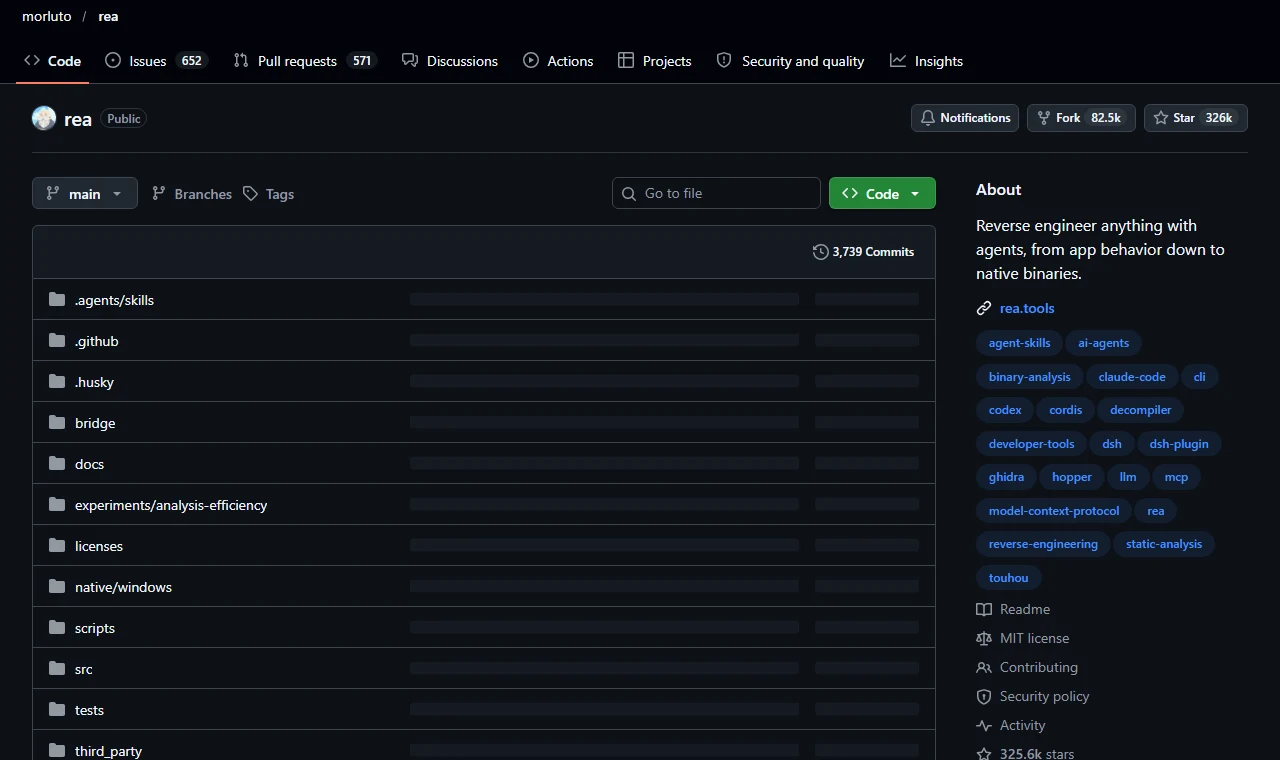
REA is an MCP server: a bridge that lets an AI coding agent run reverse engineering tools on your own machine. The project describes itself as one MCP for reverse engineering across binaries, applications and runtime behaviour. Code written by its authors is MIT-licensed, and it works with Claude Code, Codex, Cursor, Gemini CLI, Grok Build and other MCP clients.
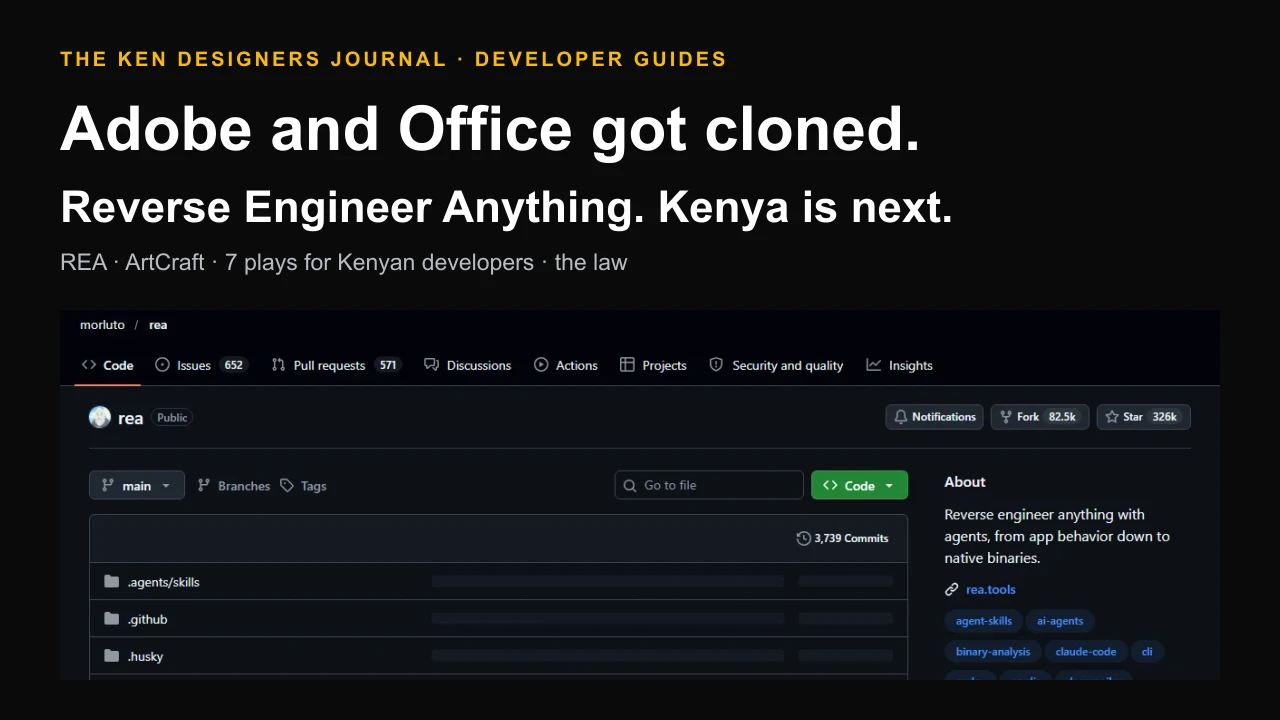
When we checked on 19 October 2026 the repository showed about 325,000 stars, 82,400 forks, 1,200 watchers and 3,737 commits on its main branch. It is one of the fastest-rising projects GitHub has seen.
None of this is new capability. A skilled reverse engineer could always open a binary in Ghidra or an APK in JADX. What REA changes is the cost. It puts a dozen tools behind one interface and lets the agent do the slow parts: tracing calls, reading pseudocode, cross-referencing strings and writing up what it found.
How a REA session works
1. You ask a question. How does this app validate a licence key? How does this smart plug talk to its cloud? Where does this POS store completed sales?
2. The agent calls REA, which runs the right local tool against the target: a decompiler for a binary, JADX for an APK, TShark for a packet capture.
3. REA returns evidence: code, references, and a list of what it could not resolve. It is designed to report what it does not know rather than guess, which is the right design for a tool whose output you may later have to defend.
4. The agent explains the behaviour, then writes and tests your own version of the feature.
| Layer | Targets | Tools REA drives |
|---|---|---|
| Native code | ELF, PE and Mach-O binaries, Go and Rust binaries, WebAssembly, .NET assemblies, EVM bytecode | Ghidra, IDA, Hopper, Rizin, objdump, GDB with pwndbg |
| Mobile | Android APKs, live devices over adb, Flutter apps | JADX, JEB, Apktool, adb |
| Apps and web | Electron and JavaScript apps, websites, Apple app bundles | Built-in JavaScript analysis, browser observation |
| Network | HAR and Fiddler captures, PCAP files | TShark, capinfos, mitmdump |
| Hardware | Firmware images, logic-analyser recordings | Binwalk, Unblob, sigrok-cli |
| Data | SQLite databases, process and filesystem behaviour | Built-in readers |
Installing REA safely
Setup needs Node.js 22.19 or later and one command. It backs up your existing agent configuration before changing anything. Restart your agent afterwards and ask it to investigate something you own.
Do not download a "Reverse Engineer Anything" zip. Because the name went viral, copycat repositories with keyword-stuffed READMEs and zip downloads have appeared. The official project is morluto/rea and installs through npm. A zip from a random fork is exactly how malware reaches developers who are curious about security tools.
The README is also clear about the law. REA is meant for lawful research, education, interoperability, software preservation and software you own or are authorised to examine. Commercial tools such as IDA and JEB must be bought; cracked copies are explicitly not authorised. Analysis runs locally, but whatever the agent reads is sent to your model provider, so client data does not belong in it.
# Node.js 22.19+ (or 24.11+) and npm
npx rea-agents setup          # pick your agents, review the changes, approve
# restart Claude Code, Codex, Cursor or Gemini CLI, then ask it to investigate

# Optional: the standalone command-line tool
npm install --global rea-agents
rea --help
rea update                    # keep the tools current
The developer who cloned Adobe, then Office
On 3 October 2026, ArtCraft founder Brandon Thomas released seven open-source Rust apps that imitate Adobe Creative Cloud, led by PhotoCraft, a Photoshop replacement. Days later he followed with WordCraft, GridCraft and DeckCraft, replacements for Word, Excel and PowerPoint, and named an AutoCAD clone, CADCraft, as next. He says he built them with Anthropic's Claude (Techstrong.ai, Futurism).
Most of the viral coverage overstates what happened, so it is worth being precise.
- They exist and they are free. The code is on GitHub, the Office clones run offline, and ArtCraft makes its money from optional AI generation credits.
- They are not finished. Thomas calls them pre-alpha. They work to varying degrees and are a long way from feature parity.
- "Reverse engineered" is loose language. Thomas describes PhotoCraft as a clean-room reimplementation: rebuilding behaviour without copying the original code. That is very different from decompiling Photoshop and publishing it, and nobody has independently checked how clean the room was.
- Nothing that belonged to Adobe or Microsoft was given away. No cracked binaries and no leaked source. What was given away is new code that looks and behaves like the originals.
- The legal fight has not started. As of mid-October neither company had commented publicly. Copyright protects code rather than function, but software licences often ban reverse engineering, and that is where liability would land.
| ArtCraft app | Imitates | Status |
|---|---|---|
| PhotoCraft | Photoshop | Layers, masks, adjustment layers, type, vectors, brushes and PSD support, by the developer's account |
| Six further Creative Cloud apps | Illustrator, Premiere, Lightroom and others | Released with PhotoCraft on 3 October |
| WordCraft, GridCraft, DeckCraft | Word, Excel, PowerPoint | Free, standalone and offline |
| CADCraft | AutoCAD | Announced |
Why the two stories belong together
Thomas put his thesis bluntly: every closed workflow will fold. Whether or not that is true, one point is hard to argue with. A very small team with an AI model can now rebuild the surface of a billion-dollar product in weeks, so the moat is moving away from code and towards data, distribution, trust and support.
ArtCraft and REA demonstrate two halves of the same skill. ArtCraft shows the rebuild: give an AI a clear picture of what a product does and it will write a working version. REA supplies the understanding: it shows an AI how an existing system works, down to the bytes, so the rebuild is accurate. Combined, they give the workflow serious teams will use from now on:
- Observe what the software does: screens, network calls, files it writes.
- Trace how it does it: decompiled functions, protocol messages, data formats.
- Specify the behaviour in plain language, without copying any code.
- Rebuild your own implementation and test it against the original's behaviour.
Where the legal line sits
The skill is neutral. What you point it at is not. We think of it as a ladder, from always fine at the bottom to plainly illegal at the top. Most of the money for Kenyan developers sits on rungs one to three; you do not need to clone Photoshop to make a good living from this.
| Rung | What it looks like | Verdict |
|---|---|---|
| 1. Your own software | Your apps, open-source code, devices you own | Always fine |
| 2. Interoperability | Making your system read a file format or talk to a device you own. The reason LibreOffice opens .docx files | Widely accepted, and expressly allowed by Kenya's Copyright Act |
| 3. Security research | With permission or under a disclosure programme, reported privately | Fine on your own copy, with responsible disclosure |
| 4. Clean-room rebuilds | One person documents behaviour; a different person, or a fresh AI session, codes from that specification only | Legal grey zone |
| 5. Cracking | Breaking licence checks, DRM or paywalls, or republishing decompiled code | Piracy, and potentially a computer misuse offence |
Seven reverse engineering plays for Kenyan developers
The best targets are close to home: systems Kenyans use every day that have little documentation, no API or no vendor left. Each play names the target, what to ask your agent, what to ship and the guardrail.
| Play | Layer | Who pays | Risk |
|---|---|---|---|
| 1. Rescue a dead POS for eTIMS | Desktop app and database | Shops, pharmacies, hardware stores | Low, with the owner's consent |
| 2. Migrate abandoned SACCO, school and clinic software | .NET or VB6 desktop | SACCOs, schools, clinics | Low, with the owner's consent |
| 3. Wire up milk scales and farm sensors | Serial or Bluetooth hardware | Dairy co-operatives, agritech | Low |
| 4. A fleet server for cheap GPS trackers | Network protocol | Boda and matatu fleet owners | Low |
| 5. Audit loan and betting apps | Android APK | Media, NGOs, regulators | Medium; disclose responsibly |
| 6. Free shop CCTV from the cloud | Firmware | SMEs, homeowners | Low on your own devices |
| 7. Clean-room a feature for low bandwidth | Web and mobile behaviour | Your own startup | Medium; never copy code |
Play 1: rescue a dead POS for eTIMS
KRA requires businesses to issue invoices through eTIMS, and thousands of shops run point-of-sale software whose vendor has closed or stopped updating it. The owner's sales history sits in a local database nobody can read, and the till cannot talk to KRA. Our guide to KRA eTIMS for online stores covers the KRA side.
Ask your agent to map where sales and line items are stored and how VAT is calculated, as a specification. Then ship a small bridge service that reads new sales and submits them through KRA's official eTIMS integration, so the shop keeps its old till.
Guardrail: the business that holds the software licence must agree in writing. You are only reverse engineering the old software to get the owner's own data out, which is the interoperability case the Copyright Act protects.
# Play 1: rescue an old point-of-sale system for eTIMS (with the owner's written consent)
Using REA, inspect the POS install folder at C:\ShopPOS and its database.
1. Find where completed sales and line items are stored, and document the schema.
2. Explain how VAT is calculated on each line.
3. List anything you could not confirm, with the evidence you do have.
Write the result as a specification. Do not copy the vendor's code.

# Then, in a fresh session that sees only the specification:
Build a small service that reads new sales using this specification and
submits them through KRA's official eTIMS integration. Include tests that
compare totals with ten real receipts.Play 2: migrate abandoned SACCO, school and clinic software
Many SACCOs, schools and clinics run Windows desktop systems written in VB6 or .NET a decade ago. The developer has moved on and there is no export button. REA's .NET analysis and SQLite readers can map how records are stored and how the business rules work.
Ask your agent to decompile the assembly and document how members, loans and repayments are stored and how interest is computed, as rules rather than code. Then build a modern web system with a tested migration script, and check the re-implemented interest rules against real member statements before anyone switches over.
Guardrail: the client must own the data and the right to use the software. Member and patient records fall under the Data Protection Act, so keep them on the client's machine and never paste them into an AI chat.
Play 3: wire up milk scales and farm sensors
Dairy co-operatives weigh milk on digital scales that print a slip and keep nothing, and farmers dispute the numbers. Most of these scales send every reading out of a serial or Bluetooth port that nobody uses.
Capture the port with a cheap USB logic analyser and sigrok, then ask your agent to decode the baud rate and message format and explain each field. Ship an Android app that records each delivery against the farmer's number and sends an SMS receipt, priced per co-operative.
Guardrail: you are reading signals from hardware the co-operative owns. Do not touch calibration, which is a weights and measures matter.
Play 4: a fleet server for cheap GPS trackers
Fleet owners buy low-cost imported GPS trackers that report to a foreign app with a monthly fee. Many of these devices speak well-known protocols such as GT06.
Give your agent a packet capture of the tracker talking to its server and ask it to identify the login, location and heartbeat packets, comparing them with the open-source Traccar decoders. Ship a locally hosted tracking dashboard with M-Pesa subscription billing and fuel and route reports for boda and matatu SACCOs. Our M-Pesa STK Push guide covers the billing side.
Guardrail: only re-point devices your customer owns, and start from open-source projects like Traccar before writing a decoder from scratch.
Play 5: audit loan and betting apps for data abuse
Digital lenders have a history of harvesting borrowers' contacts and using them to shame people into paying. In September 2023 the Office of the Data Protection Commissioner fined Mulla Pride, which runs the KeCredit and Faircash apps, KES 2.975 million for exactly this (NTV Kenya). Decompiling an APK shows which permissions an app uses, which tracking SDKs it ships and where the data goes.
Ask your agent to decompile the APK with JADX through REA and list every permission, third-party SDK and network endpoint, showing where contacts, SMS or location are read. Then publish the research, build a privacy scorecard for popular Kenyan apps, or send findings to the company and the ODPC.
Guardrail: work on the app as installed on your own phone, with your own data. Do not probe the company's servers, and do not publish anything exploitable before it has had a reasonable time to fix the problem.
Play 6: free shop CCTV and smart devices from the cloud
Cheap DVRs, Wi-Fi cameras and smart plugs fill Kenyan shops and homes. Many ship with default passwords and report to servers abroad.
Ask your agent to unpack the firmware with Binwalk and Unblob and find default credentials, open services and cloud endpoints. Then sell a hardening service to SMEs: change the defaults, block the cloud calls and set up local recording.
Guardrail: your devices, or a client's with consent. Scanning other people's cameras on the internet is an offence under the Computer Misuse and Cybercrimes Act.
Play 7: clean-room a global feature for low bandwidth
Your product wants the instant search of a big notes app or the offline sync of a global messaging app, tuned for patchy 3G and expensive bundles.
Ask your agent to observe how the app behaves offline and back online and describe the sync strategy as a specification, with no code. Then, in a fresh session that sees only the specification, ask it to implement that for your own app.
Guardrail: keep the specification and the implementation separate, and keep the specification. That paper trail is your clean-room defence if anyone ever asks.
An eight-week path from zero
Agents make reverse engineering faster, but they do not replace knowing what you are looking at. If you cannot read the pseudocode REA hands back, you cannot tell when the agent is wrong. Learn the fundamentals by hand, then let the agent take over the slow parts.
The whole toolkit is free: Ghidra for native binaries, JADX and Apktool for Android, Wireshark for network traffic, mitmproxy for an app's HTTPS calls on a test phone you own, Binwalk and Unblob for firmware, and sigrok with a cheap USB logic analyser for hardware. An old Android phone you can reset and a laptop with 8 GB of RAM complete the lab.
Practise with others. picoCTF and crackmes.one cover reversing, pwn.college goes deeper, and AfricaHackOn, OWASP Nairobi and BSides Nairobi bring the local community together. A public repository that clearly explains how you decoded one protocol is a stronger CV than a certificate.
| Week | Focus | Practise on | Then ask REA |
|---|---|---|---|
| 1 | How programs are built: C, compilers, basic assembly | A small C program of your own, opened in Ghidra | Explain what each function in this binary does |
| 2 | Reading decompiled code | Beginner challenges on crackmes.one and picoCTF | Compare its explanation with your own notes |
| 3 | Android internals | An app you wrote yourself | List the permissions, SDKs and endpoints in this APK |
| 4 | Network protocols | Your own laptop's traffic | Summarise every host this capture talks to and why |
| 5 | Files and databases | SQLite files from an app on your own phone | Document this schema and how the tables relate |
| 6 | Firmware | A router firmware from the vendor's download page | Find the services, default configuration and update URLs |
| 7 | One Kenyan play | Any of the seven plays above | Run the full observe, trace, specify, rebuild loop |
| 8 | Write it up | A blog post or public repository of your findings | Review the write-up for gaps and unsupported claims |
Kenyan law is friendlier than you think, until it is not
Kenya's Copyright Act expressly allows decompiling a program to make it work with other programs. Section 26A(3), added by the Copyright (Amendment) Act 2019, means you do not need the rights holder's permission to decompile software for the information needed for interoperability (CIPIT, Strathmore University). Section 26A(2) also lets a lawful owner copy software to correct errors, test it or keep a backup.
Five rules keep you on the right side: own it or get permission in writing; analyse locally, never the company's servers; never publish someone else's code; keep personal data out of AI chats; and disclose vulnerabilities privately, giving the company time to fix them (90 days is a common norm) before involving the ODPC or the National KE-CIRT/CC.
This is not legal advice. If a project touches a large company's product or real customer data, an hour with an IP or technology lawyer is cheap insurance.
| Law | What it forbids | Maximum penalty |
|---|---|---|
| Computer Misuse and Cybercrimes Act 2018, s.14 | Gaining access to a system by infringing its security measures, knowing the access is unauthorised | KES 5 million, three years, or both |
| Computer Misuse and Cybercrimes Act 2018, s.16 | Interfering with a system, program or data without authority | KES 10 million, five years, or both; KES 20 million or ten years where it causes significant loss or harm |
| Data Protection Act 2019 | Processing people's personal data without a lawful basis | ODPC penalties, as Mulla Pride found |
| Licence agreements | Many licences ban reverse engineering outright | A contract claim can apply even where copyright does not |
The next ArtCraft could come from Nairobi
The ArtCraft story is not really about Adobe. It shows that a small team with AI can rebuild the surface of almost any software in weeks. REA's star count shows that developers everywhere want the other half: the ability to understand any system they are handed.
Kenya has a particular advantage. Our economy runs on systems that were never documented for us. The developer who can open those systems, explain them and build a clean bridge to them will not run out of work. Start this week: install Ghidra and JADX, open an app you built yourself, run REA against it, then pick one play from this guide and find one real business that has the problem. If you would rather have us build the bridge, see our custom software development service.
Questions people ask
What is REA, Reverse Engineer Anything?
REA is an open-source, MIT-licensed MCP server on GitHub (morluto/rea) that lets AI coding agents such as Claude Code, Codex and Cursor drive reverse engineering tools like Ghidra, JADX, TShark and Binwalk. The agent asks a question, REA runs the tool locally and returns evidence, and the agent explains the behaviour or builds your own version of it.
Is it legal to use REA in Kenya?
Using the tool is legal; what matters is the target. Analysing your own software, devices you own or a client's systems with written permission is fine, and section 26A(3) of the Copyright Act allows decompiling for interoperability. Breaking into systems, bypassing licence checks or publishing someone else's decompiled code is not.
Did ArtCraft use REA to clone Adobe and Office?
No. Brandon Thomas says he built the ArtCraft apps with Anthropic's Claude and describes them as clean-room reimplementations. REA is a separate project. The two went viral in the same month because both show how far AI-assisted software work has come.
Are the ArtCraft apps a real replacement for Photoshop or Excel?
Not yet. The developer calls them pre-alpha. They are free, open source and promising, but for client work today you should still rely on mature tools such as the originals, LibreOffice, GIMP or Inkscape.
Can I reverse engineer M-Pesa or a bank app?
Do not. For payments, use Safaricom's official Daraja API, which is documented and free to integrate. Probing a payment provider's systems risks offences under the Computer Misuse and Cybercrimes Act. Auditing what an app does with data on your own phone is research; attacking its servers is not.
Where should a beginner start?
Install Ghidra and JADX, open a program or app you wrote yourself, and work through beginner challenges on picoCTF and crackmes.one. Once you can read decompiled code by hand, add REA so an agent can take over the slow parts. The eight-week plan in this guide sets out one focus a week.
Put this guide to work
Download a practical template, fill in your requirements and bring it to your project conversation.
- Reverse engineering project checklist ↓
Permission, scope, safe install, the observe-trace-specify-rebuild loop, data protection and responsible disclosure steps in one printable list.
Sources and research notes
Sources checked 19 October 2026. Recommendations and labelled scenarios are editorial guidance. Provider prices and capabilities can change; confirm them before purchasing.
- REA: Reverse Engineer Anything (morluto/rea)
Purpose, supported targets and tools, setup commands, licence, disclaimer and repository metrics. Screenshot captured from this repository.
- Code Newsletter: how devs are using the viral reverse engineering repo
How developers are using REA, and its terms-of-service cautions (17 October 2026).
- Techstrong.ai: ArtCraft's Adobe and Office clones
ArtCraft release date, app names, Rust, Claude, the clean-room claim, pre-alpha status and the lack of company comment.
- Futurism: creator of free Adobe suite reverse engineers Microsoft Office
WordCraft, GridCraft and DeckCraft, offline use and ArtCraft's AI credit business model (14 October 2026).
- CIPIT, Strathmore University: exceptions to computer programme copyright infringement
Section 26A of the Copyright Act, including decompilation for interoperability.
- Computer Misuse and Cybercrimes Act 2018, section 14
Unauthorised access offence and penalty (unofficial reproduction).
- Computer Misuse and Cybercrimes Act 2018, section 16
Unauthorised interference offence and penalties (unofficial reproduction).
- NTV Kenya: mobile loans firm fined for accessing borrowers' phone books
ODPC penalty against Mulla Pride (KeCredit, Faircash), September 2023.

About this guide
AI-assisted research and original buyer checklists from the studio. Official documentation is linked above; examples are illustrative and do not describe verified client outcomes.
Ask Ken on WhatsApp